Undigitised European print · supply for machine-learning programmes
European long-tail print, measured two ways.
Every lot is graded title by title against the German National Library, HathiTrust, Internet Archive and Open Library. We report two numbers: how much of it has never been digitised — and how much of it no one but Google can access.
Frontier model competition is an input competition.
Coverage is document-bound.
A model's ability to answer a factual question tracks the number of relevant documents in its pre-training data; the relationship is causal, and scale does not substitute for missing documents (Kandpal et al., ICML 2023). Retrieval reaches only what is online. Text that was never digitised is absent from both channels — not in the corpus, not in the index.
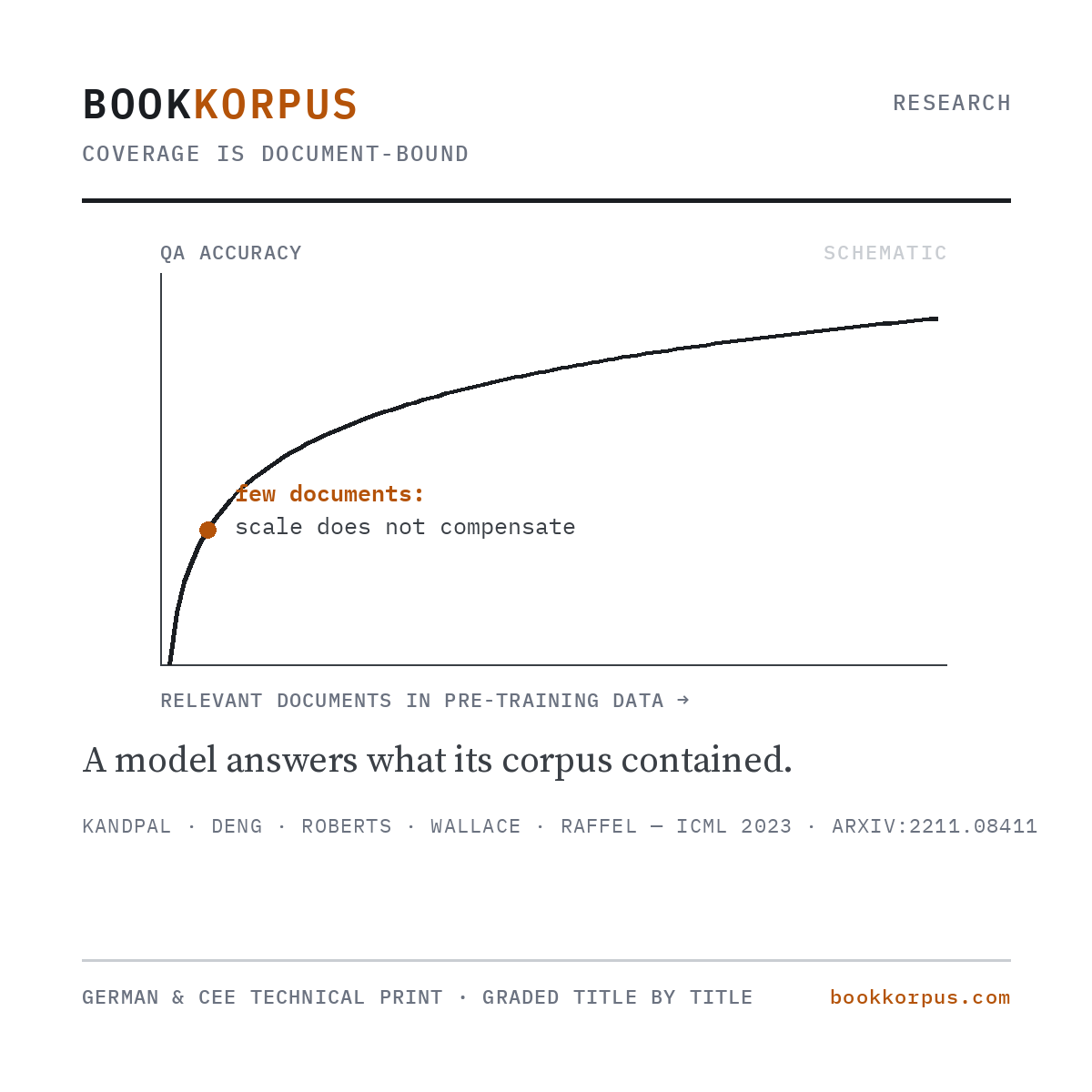
Source — Kandpal · Deng · Roberts · Wallace · Raffel, ICML 2023 · arXiv:2211.08411
Unique tokens are the constraint.
At fixed compute, curated data behaves like additional compute: comparable MMLU at 6.6× less compute (DCLM, 2024); matched benchmarks on ~10× fewer tokens (FineWeb-Edu, 2024). At long training horizons, datasets win on unique real tokens (Nemotron-CC, 2024) — uniqueness, not volume, is what runs out.
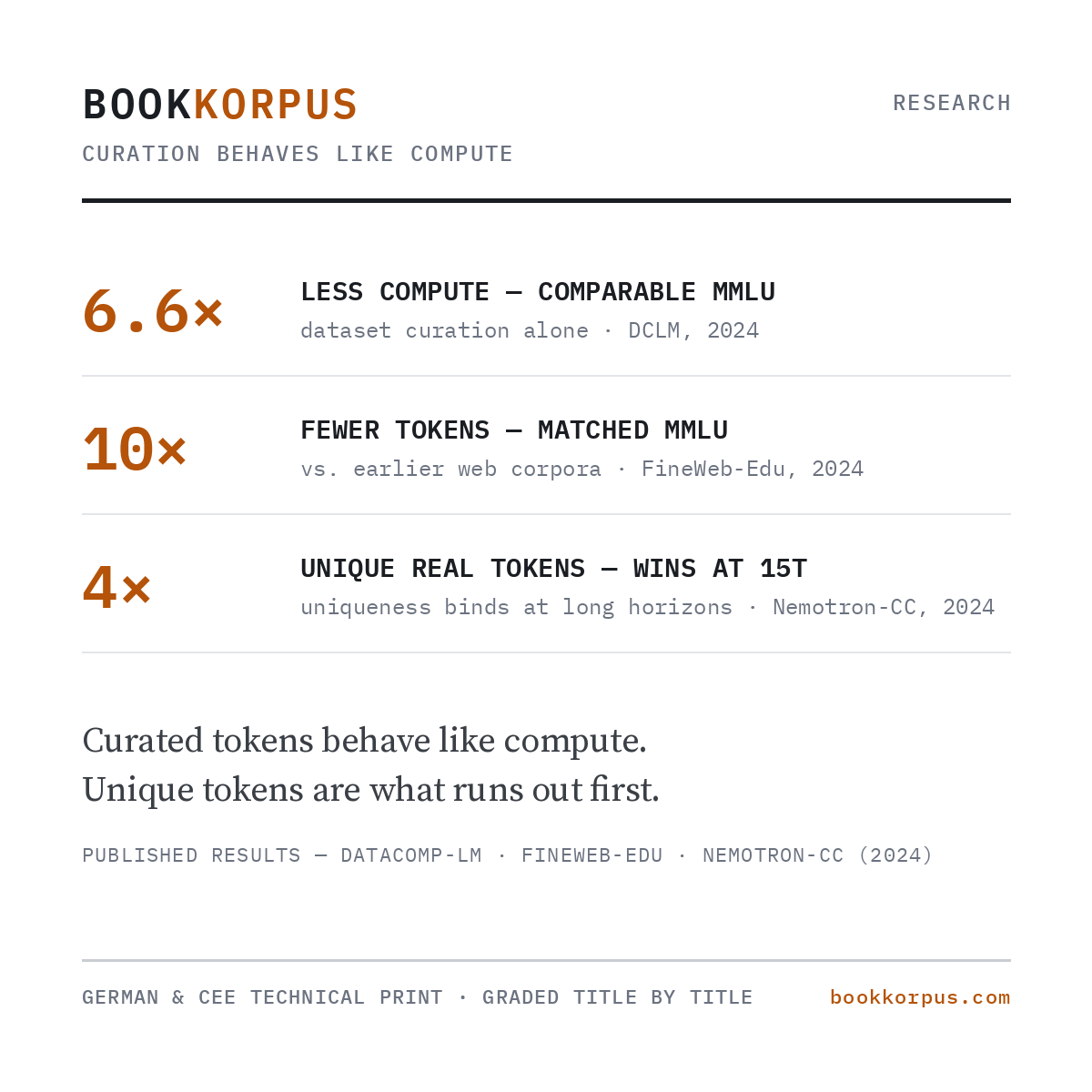
Source — DataComp-LM · FineWeb-Edu · Nemotron-CC, 2024
The stock is finite, and the remainder is named.
The effective stock of human-generated public text is estimated at ~300 trillion tokens (90% CI: 100T–1,000T), fully utilised between 2026 and 2032 if trends continue (Epoch AI, 2024). Among the small, very high-quality sources the researchers name as still untapped: documents in libraries, not yet digitised.
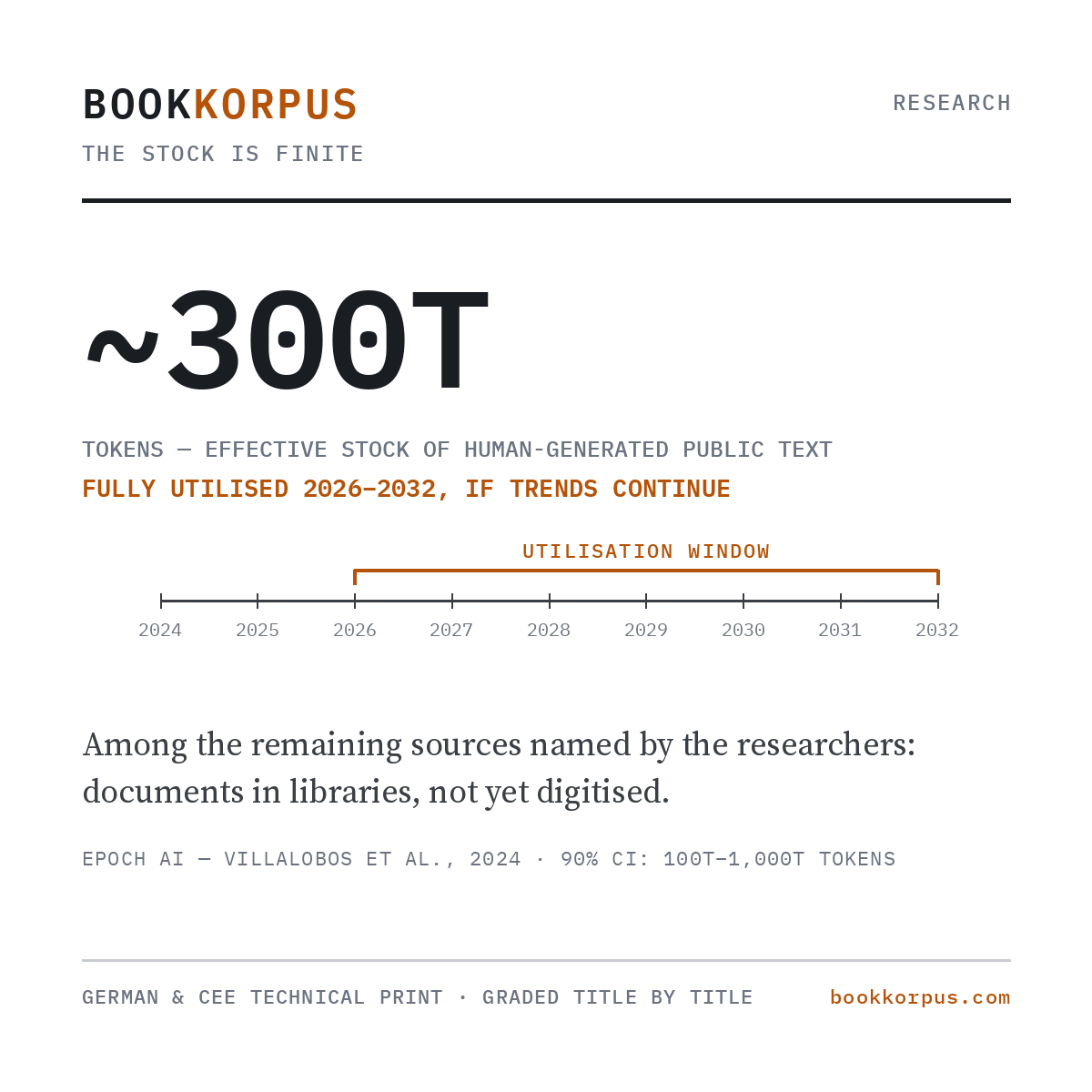
Source — Epoch AI, Villalobos et al., 2024 · arXiv:2211.04325
Training runs at the frontier are billion-dollar-scale bets on inputs. The web is shared infrastructure — every lab crawls it, filters it, deduplicates it; whatever advantage it conferred is priced in. What remains contested is text that never went online. BookKorpus exists to supply exactly that: German and Central European technical print, sourced on the ground, graded title by title, verified absent from the public digital record — with the grading sheet to prove it.
Figures as published; estimates as of the 2024 publications. Full citations: references.
Most of what Europe printed in the last century was never digitised, and bulk supply chains deliver the opposite of what training pipelines need from print: high-duplication English mass stock — the same titles, many times over.
Of what was scanned, a large share sits inside Google's library programme: searchable at most, readable by no one, usable by no buyer except Google. For every other lab, a closed scan is no scan — the physical volume is the only route to the text.
The long tail of German, Czech, Polish and Hungarian technical and professional literature surfaces in places volume buyers never see. Reaching it takes language, catalogue knowledge and sourcing infrastructure — not tonnage.
| Composition | Curated pallet lots. Title diversity by design: one copy per edition, not multiples. |
|---|---|
| Coverage | Technical, academic, professional and regional literature. German-language core, extending across Central and Eastern Europe. |
| Grading | Title by title against DNB, HathiTrust, Internet Archive and Open Library. Four grades per title, check date on every sheet, under a published, versioned definition. |
| Two KPIs | Never digitised (grades A+B) · not openly available (grades A+B+C) — sampled per lot, sample size stated. The second number is the one that counts for a training-data buyer. |
| Sourcing | Estate, institutional and business-closure collections across Germany and Central Europe, reached through a proprietary monitoring pipeline before stock enters normal trade channels. Channel detail is shared in direct conversation. |
| Fulfilment | Full chain in-house: acquisition, consolidation at our German depot, grading, palletising, export documentation and freight to EU and US destinations. |
| Confidentiality | NDA-comfortable. The full title-level grading sheet (CSV) accompanies every sold lot; samples, volumes and terms are discussed directly, not published here. |
| Ref | Title / imprint | Grade | Finding |
|---|---|---|---|
| K-2417 | Vodní hospodářství v povodí Moravy Brno, 1961 |
A | no scan found, 4/4 sources · scarce in the trade |
| K-2418 | Berechnung stählerner Fachwerkbrücken Leipzig, 1953 · 2. Aufl. |
B | no scan found, 4/4 sources |
| K-2419 | Lehrbuch der Gerbereichemie Dresden, 1949 |
C | HathiTrust search-only — scan exists, access closed |
| K-2420 | Einführung in die höhere Mathematik, Bd. 2 Berlin, 1967 · 9. Aufl. |
D | open full text (Internet Archive) |
| K-2421 | Zeitschrift für Binnenschiffahrt, Jg. 1938 bound periodical volume |
unknown | fuzzy match — graded conservatively, not counted toward A/B |
The specimen above is an illustrative composite; field structure, grades and KPI logic are exactly as shipped. Figures are sampled, not guaranteed for the whole lot, and unknown-graded titles never count toward a KPI. All check sources are public catalogues, so any row of a delivered sheet can be re-checked. The grades describe digitisation and accessibility status only — they say nothing about usage or licence rights. Definition and limits: methodology.
The sourcing pipeline monitors estate and institutional collections continuously; single acquisitions range from a few hundred to several thousand volumes, and the infrastructure is built for programme supply — recurring container shipments running to five- and six-figure annual volume counts.
| Pilot lot | One pallet, 300–600 volumes, with the full grading sheet. Sized to let a buyer verify the grading against their own checks before committing further. |
|---|---|
| Production lots | Multi-pallet shipments consolidated at the German depot, to an agreed subject and grading profile. Road freight within the EU, LCL sea freight to the US. |
| Programme supply | Standing monthly or quarterly supply at container scale (20 ft FCL ≈ 8–10 pallets), against a grading specification agreed per programme. |
Every engagement starts with a pilot. We would rather prove the grading on one pallet than promise a container.
- 01Source. Estates, institutional clearances and business wind-downs across Germany and Central Europe, monitored by a proprietary pipeline and reached before stock enters normal trade.
- 02Consolidate. Collection runs feed our depot in Germany, where stock is shelved, photographed and sampled for grading.
- 03Grade. Title-level cataloguing; grades and both KPIs computed under the published definition; a grading sheet (CSV) produced per lot.
- 04Pack. One copy per edition. Pallets stacked, wrapped and inventoried, with a packing list per pallet.
- 05Ship. Road freight within the EU; LCL or full-container sea freight to the US. Incoterms FCA (our depot) or DAP; export documentation handled; DAP with the buyer as importer of record supported.
BookKorpus is a specialist operation: sourcing, cataloguing and grading run on a proprietary pipeline built end to end — built as infrastructure, designed to scale or to integrate into a larger data-acquisition operation. We keep the operation small and the claims checkable.
A decade in data-driven marketing and analytics for European financial brands including Barclaycard, TARGOBANK and Virgin Money, then large-scale public-data work — machine-learning document extraction and entity resolution at register scale at Cracking Data, a sister operation of the same company. At BookKorpus he specifies the grading, leads sourcing directly as a native German speaker, and runs every buyer conversation personally.
On the ground, a German field team handles viewings, collection runs and day-to-day depot operations; grading and buyer-facing work stay with the founder.
For lot availability, grading sheets and terms:
We reply within one business day.